Elegy
ongoing performance & installation project
2015-2026
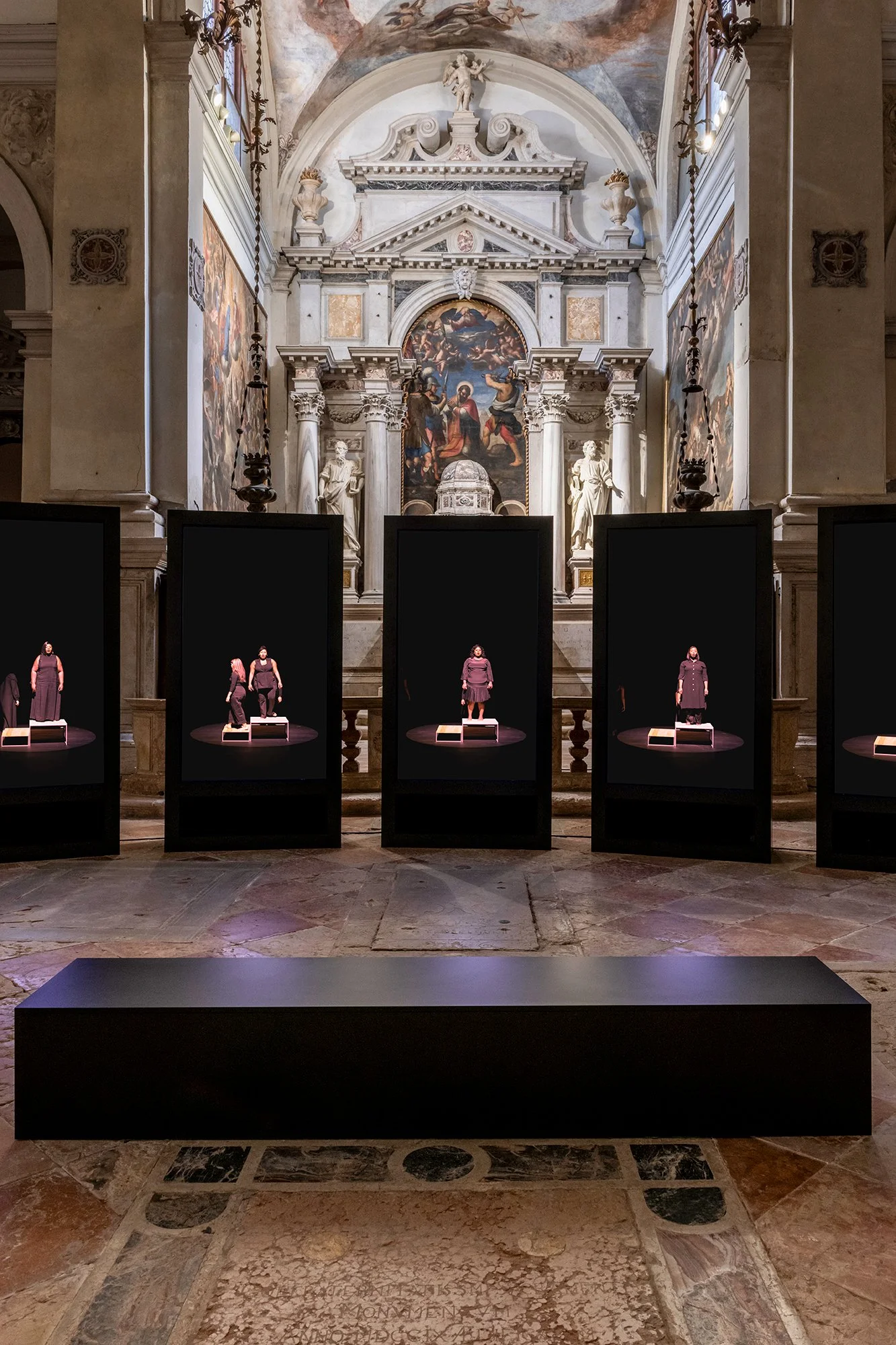
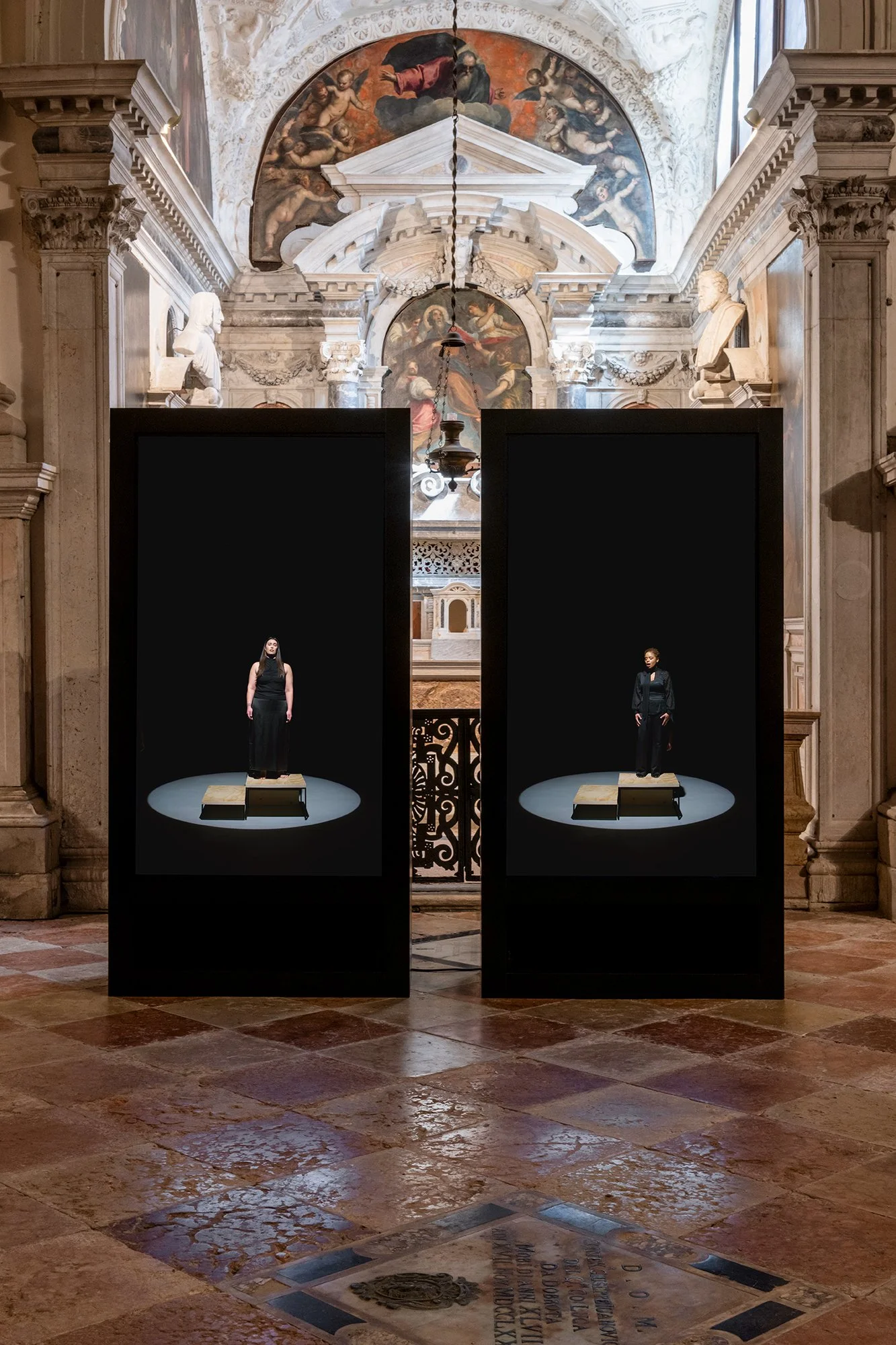
Elegy is a lifework of mourning. It is a cry, a lament, a tender refrain of remembrance, repair and black feminist love.
For over a decade now, Gabrielle Goliath has staged performances of Elegy across South Africa and the world, invoking the absent presence of women and LGBTIQ+ people lost to fatal acts of racial-sexual violence. In each performance, a group of seven women singers enact a ritual of mourning, collectively sustaining a single, haunting tone for the course of an hour. As one singer falters, another steps up to pick up the note, and so it continues, a cyclic threading of shared breath and voice.
Each performance of Elegy is accompanied by a eulogistic text, scripted by a family member or friend of the individual commemorated: for Sinoxolo, Koketso, Noluvo, Lerato, Kerabo, and more… Other performances address historical cases of violence against women and otherwise-feminised bodies in colonial and slaveocratic contexts. For these, speculative texts by collaborating scholars reach across generations, geographies and archival erasures, recalling these ‘past’ losses and accounting for a present of anti-black, anti-femme violence.
Refusing spectacle and the objectification of bodies deemed rapeable and killable, Elegy asserts conditions of hope and avowal: affirming black, brown, indigenous, femme, queer and trans lives as loveable and grieveable. It is a work of regard, of specificity and care. For those immersed in its sonic vigil, it offers a space for shared grief and radical refusal - for the urgent, ongoing lifework of mourning.
. . .
Elegy in Venice…
In 2024, the artist marked 10 years of Elegy with a 10-channel video and sound installation, tracking performances from Johannesburg to Cape Town, São Paulo, Basel, Munich and Amsterdam. She then proposed an expanded installation of three new suites of Elegy performances, following her unanimous selection for the South African Pavilion at the 2026 Venice Biennale. The exhibition was, however, subsequently cancelled by South African Minister of Sport, Arts & Culture, Gayton McKenzie, who sought to censor the work’s commemoration of Palestinian women and children killed in Gaza. The cancellation came as a shock to many, given South Africa’s ongoing case against Israel at the International Court of Justice, on charges of genocide. Along with curator Ingrid Masondo, Goliath and her studio challenged McKenzie in court, with pro bono assistance from a legal team headed by Advocate Adila Hassim of the South Africa ICJ team, and with the support of Campaign for Free Expression, who joined the case as amicus curiae. Disappointingly, the case was dismissed just hours before the final deadline for National Pavilion submissions, with charges assigned to the artist, curator and studio. Appealing the decision is a matter of principle for Goliath and her team, as McKenzie’s actions set a dangerous precedent for the South Africa arts community, undermining as they do constitutional rights to freedom of expression.
In the wake of cancellation, friendships and solidarities have carried the work forward. Whilst the South African Pavilion has remained empty, Goliath moved ahead with an independent exhibition of Elegy in Venice, with the support of Bertha Foundation, Ibraaz, ICA Milano, Galleria Raffaella Cortese and the Friends of Elegy.
Sounding within the sacral chamber of the Chiesa di Sant’Antonin - an historic church not far from the Arsenale and Giardini Biennale venues - are three new suites of Elegy performances. Together they tend to an entanglement of hurts, from the crisis of rape culture and femicide in South Africa, to the erasure of Ovaherero and Nama life-worlds in Namibia, and the orchestrated displacement and killing of Palestinian women, children, and civilians. Those commemorated include South African student Ipeleng Christine Moholane, two murdered Nama women ancestors (whose names remain unrecorded in the colonial archive), and Palestinian poet Heba Abunada, who was killed in an Israeli airstrike in Khan Yunis, Gaza, in October 2023. Arranged across eight funereal screen monoliths, the collective voices and visuals of these performances bathe participants in light and sound, drawing them into a shared labour of imagination, connection and care.
The exhibition will travel to Ibraaz in London (October 2026), ICA Milano (January 2027), and Sharjah Biennial 17 (January 2027).
. . .
Further links & details:
Elegy - three suites (Venice), 2026
Elegy - 10-channel video & sound installation, 2024
Elegy - performances, 2015-2026
Elegy - Noluvo Swelindawo (portraits), 2017