Elegy - three suites
8-channel video & sound installation
Elegy - for a poet, 2026
Elegy - for two ancestors, 2025
Elegy - Ipeleng Christine Moholane, 2025
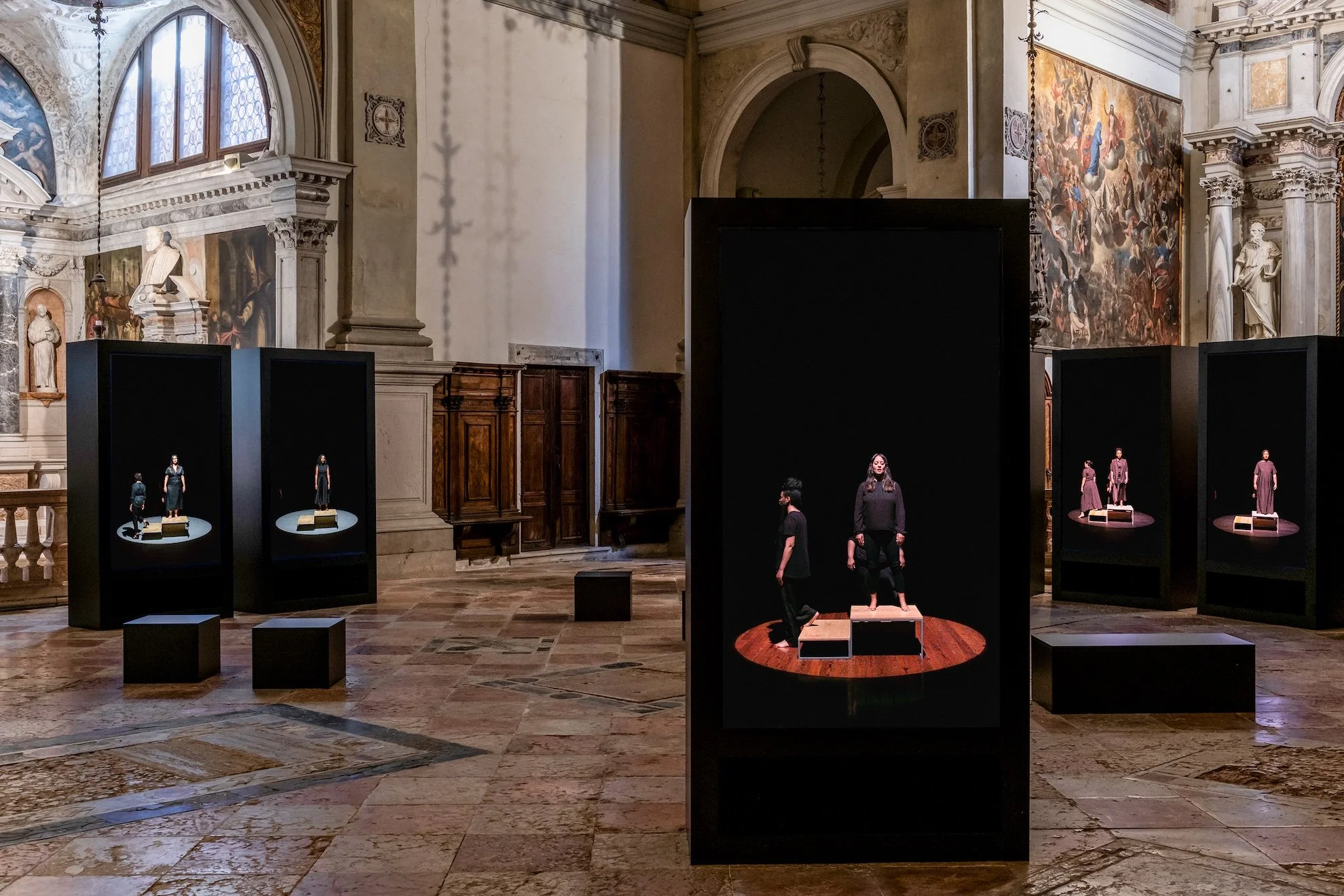
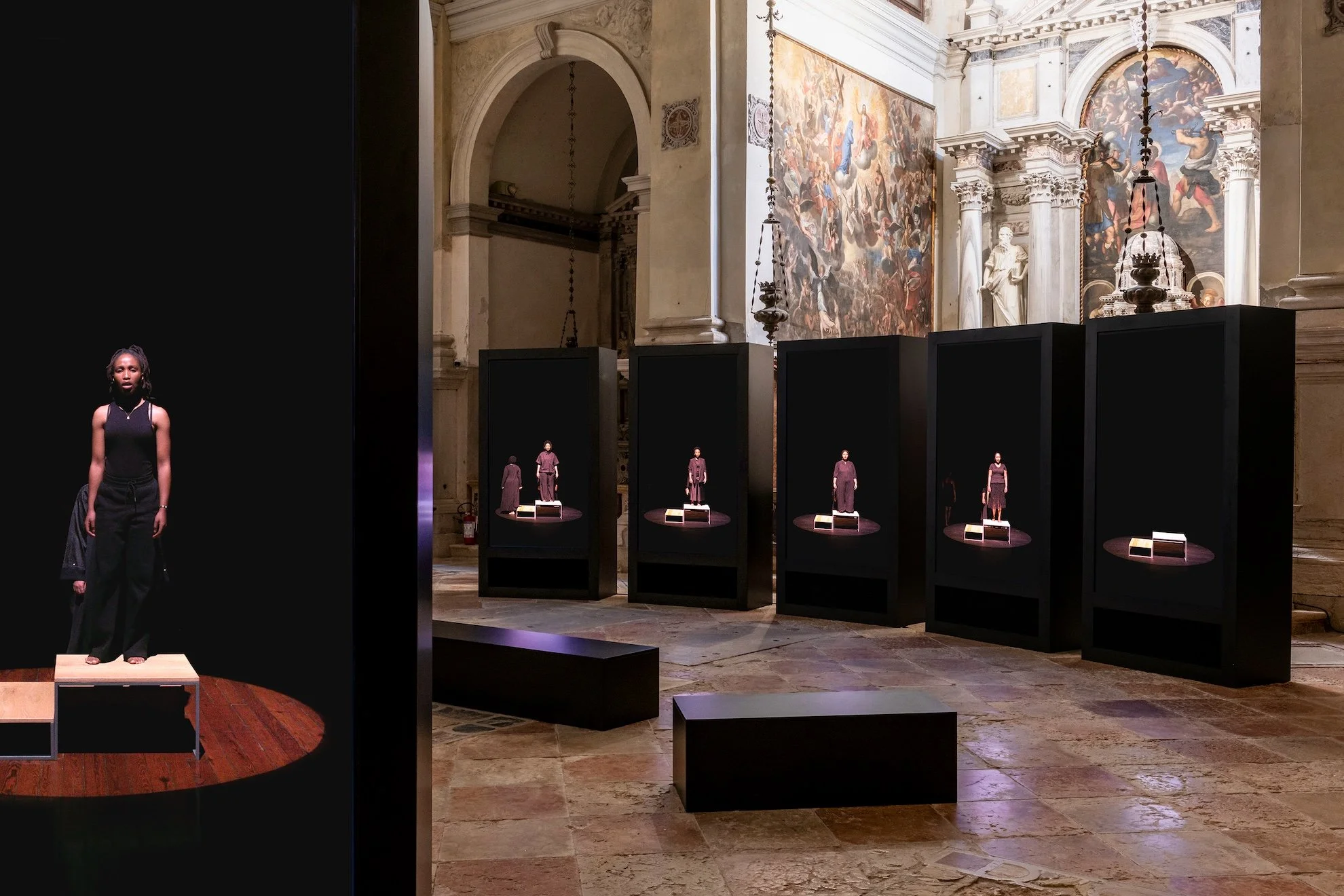
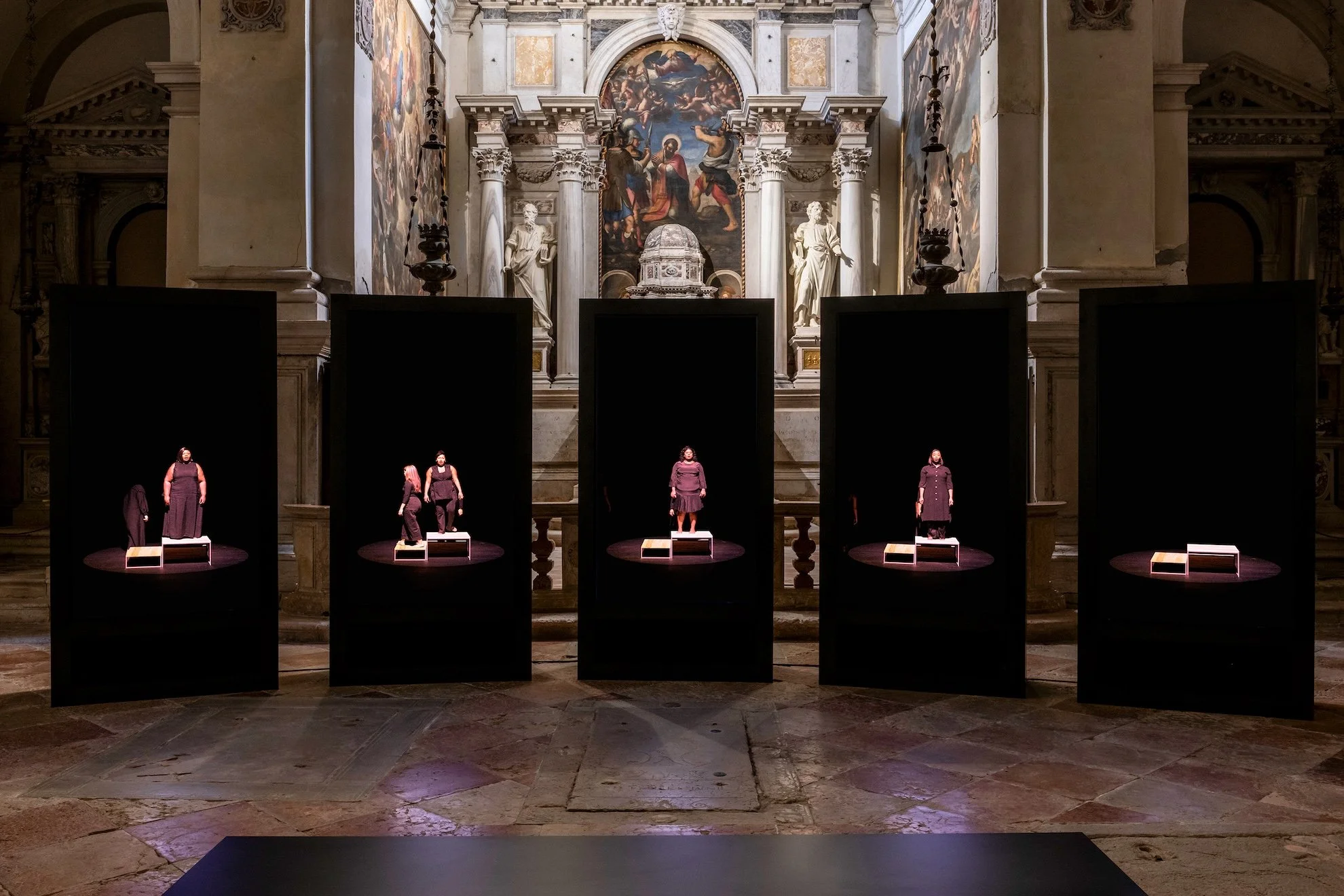
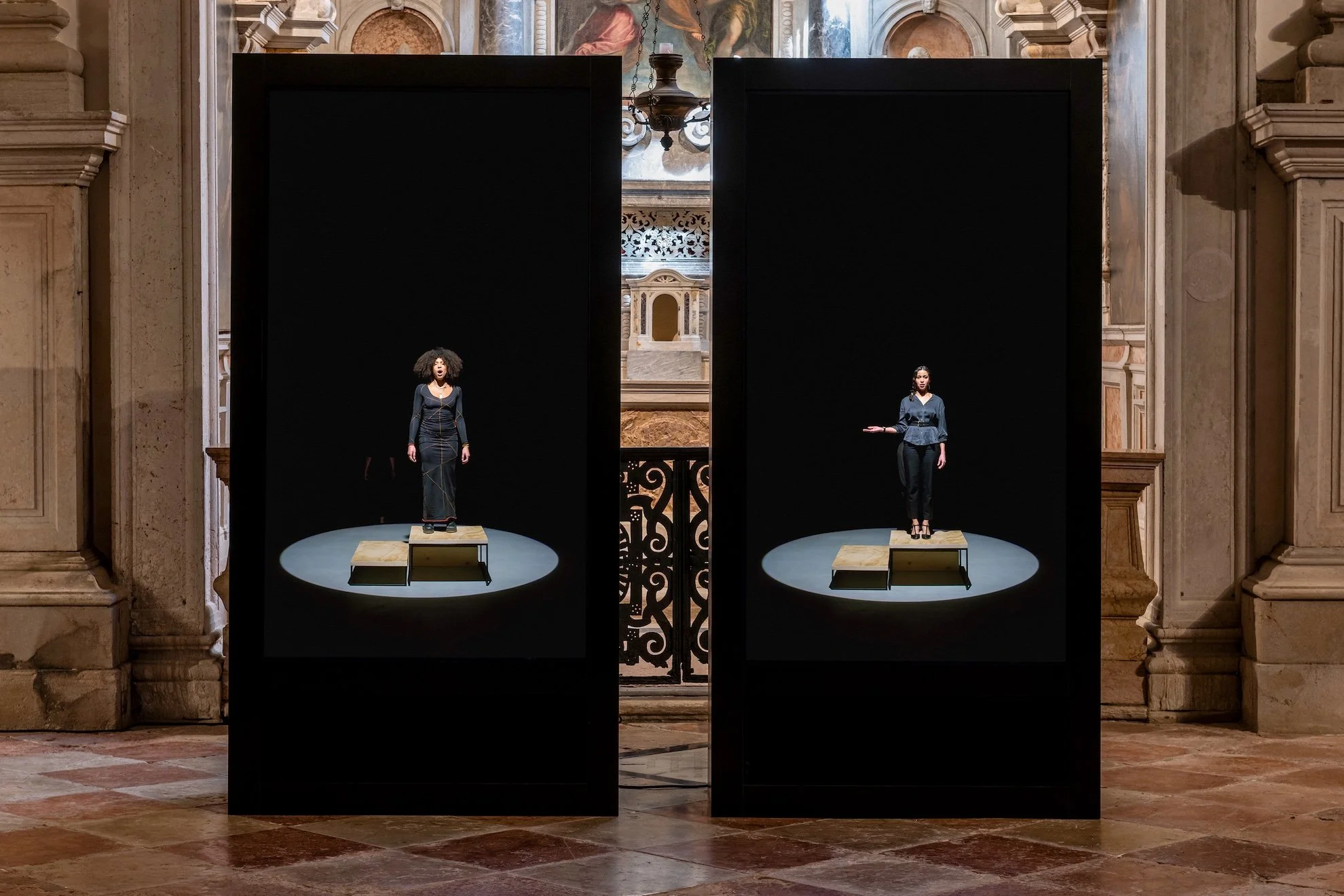
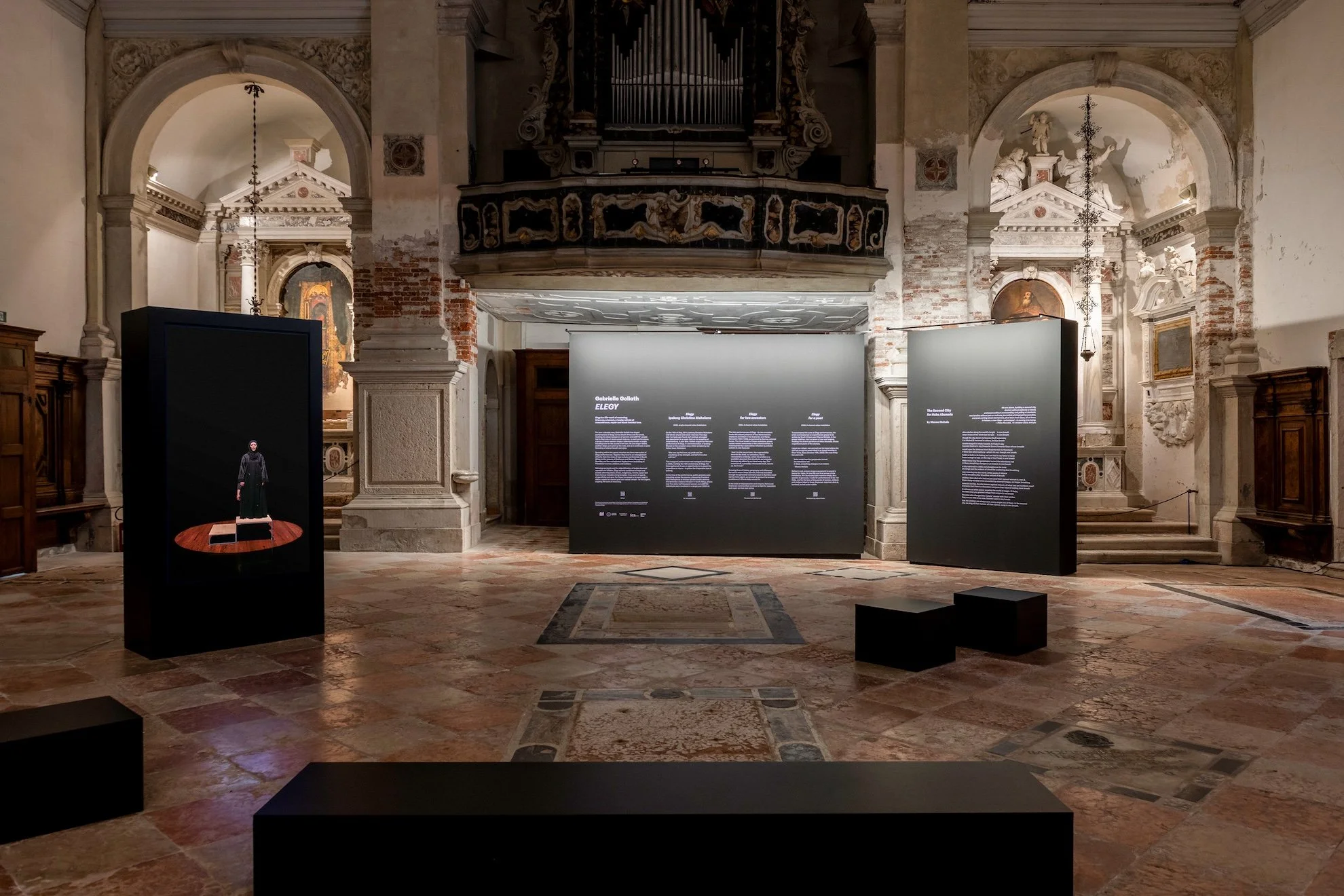
For over a decade now, Gabrielle Goliath has staged performances of Elegy across South Africa and the world, invoking the absent presence of women and LGBTIQ+ people lost to fatal acts of racial-sexual violence. In each performance, a group of seven women singers collectively sustain a single, haunting tone for the course of an hour. As one singer falters, another steps up to pick up the note, and so it continues: a cyclic threading of shared breath and voice.
Sounding within this immersive installation are three new suites of Elegy performances. Together they tend to an entanglement of hurts, from the crisis of rape culture and femicide in South Africa, to the erasure of Ovaherero and Nama life-worlds in Namibia, and the orchestrated displacement and killing of Palestinian women, children, and civilians.
Refusing spectacle and the objectification of bodies deemed rapeable and killable, Elegy asserts conditions of hope and avowal: affirming black, brown, indigenous, femme, queer and trans lives as loveable and grieveable. It is a work of regard, of specificity and care. For those immersed in its sonic vigil, it offers a space for shared grief and radical refusal - for the urgent, ongoing life-work of mourning.
. . .
Elegy - Ipeleng Christine Moholane
2025, single-channel video installation
On the 16th of May, 2014, Ipeleng Christine Moholane (19) left for church and never returned. Five days later her body was found, half-clothed, strangled and abandoned in an open field on the outskirts of Johannesburg. A year later, Goliath staged her first ever performance of Elegy, in commemoration of Ipeleng. Shared on the occasion was a letter scripted by her father, Isaac Moholane:
“She was my first born, my pride and the excellency of my strength, and half of me died with her.”
This inaugural performance was restaged and filmed in 2025, marking the 10th anniversary of Elegy. For those gathered, it was an opportunity to re-assert the imperative to mourn – to grieve the irreparable loss of Ipeleng.
At the time of the performance, public protests were mounting across the country, pressuring President Cyril Ramaphosa to declare gender-based violence and femicide a national disaster in South Africa, where over five and a half thousand women and LGBTIQ+ individuals were murdered in a single year (2023-4).
. . .
Elegy - for two ancestors
2025, 2-channel video installation
The twin performances of Elegy - for two ancestors invoke the absent presence of two Nama women, displaced and killed in the Ovaherero and Nama Genocide (1904-1908), perpetrated by German colonial forces. The ritual lament of these ancestors, whose names remain unrecorded in the colonial archive, is accompanied by a speculative reflection by scholar-activist Dr. Zoé Samudzi:
“And it is this sacred task, this responsibility towards the dead, our ancestors, that is necessarily a profanity, where the profane is a quotidian grammar that structures our everyday because we attend to our dead every day. This sacred truth, a possibly
unknowable truth, haunts us. As it must.”
Crossing lines of history, geography and difference, the call to mourn those starved, interned and killed through the genocidal colonial project in Namibia could not be more urgent, as we seek to account for present conditions of differentially valued life.
In the wake of dispossession and erasure, Nama and Ovaherero communities continue to fight for reparation and repair on their own terms.
Read This sacred task, by Zoé Samudzi
. . .
Elegy - for a poet
2026, 5-channel video installation
To accompany this suite of Elegy performances, the artist commissioned an experimental ghazal to be written by South African poet Maneo Mohale. In the ghazal tradition, this is a poem of love and longing, invoking the absent presence of Heba Abunada, whose magnificent poem of five stanzas, I grant you refuge, was penned just ten days before she and her young son were killed in an Israeli airstrike in Khan Yunis, Gaza (October 10th, 2023). She was thirty-two years old.
Heba wrote how the gunpowder turned the televisions red
in Gaza, everything changes in an instant.
- Maneo Mohale
Bathed in red, sixteen singers sound and re-sound a lament for Heba. On the fifth and final screen of the installation, the illuminated dais remains empty. As a spectre of genocide, it calls for performances to be - for Heba, and for the tens of thousands of women, children and civilians killed in Gaza: displaced, deprived, shot at, bombed, buried under rubble..
Read The Second City, by Maneo Mohale
. . .
Elegy - three suites (2025-2026) was first exhibited as an independent exhibition at the Chiesa di Sant’Antonin, Venice (5 may-31 July 2026), following the shocking cancellation of the South African Pavilion at the Venice Biennale by Sport, Arts & Culture Minister Gayton McKenzie. Elegy in Venice was made possible through the generous support of Bertha Foundation, Ibraaz, ICA Milano, Raffaella Cortese, and the Friends of Elegy. The exhibition will travel to Ibraaz London in October 2026, ICA Milano in January 2027, and Sharjah Biennial 17 in January 2027.
. . .
Installation views
Previews (request access)